Budgets & Forecasts
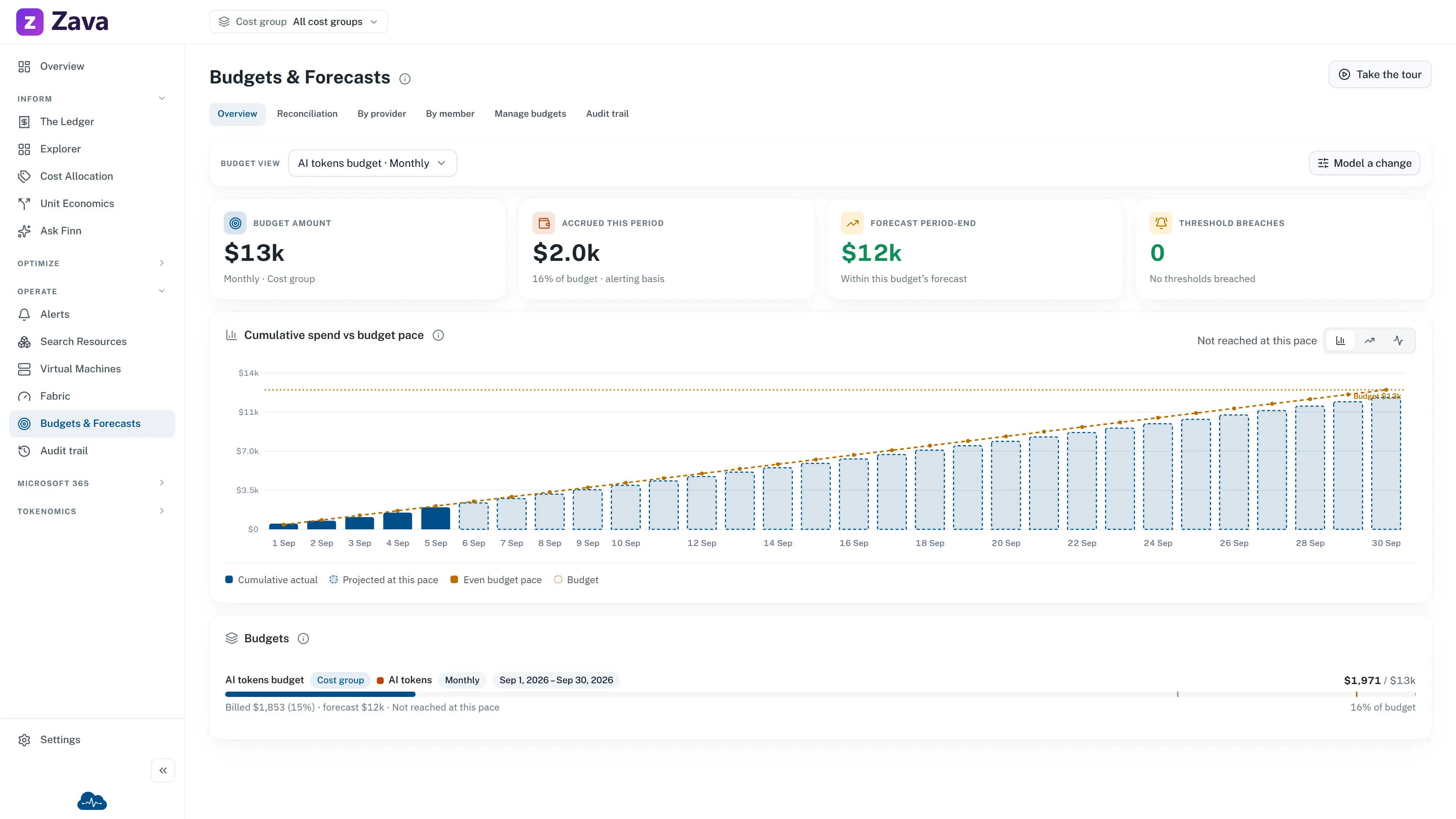
Where every budget stands against what’s actually been spent, with a projection of where the period finishes.
Ways to look at it
Section titled “Ways to look at it”Portfolio overview shows every budget side by side.
Or pick one budget for a comparison against its own native period. That distinction matters: a portfolio can mix monthly, quarterly and annual budgets with overlapping scopes, so the figures sit alongside each other and are never summed. Adding an annual budget to a monthly one produces a number that means nothing.
Reading the pacing
Section titled “Reading the pacing”Cumulative spend vs budget pace is the chart to look at. It plots spend so far against the line you’d be on if you spent evenly through the period.
A monthly budget is plotted day by day, so there is a shape to read inside the cycle rather than a single bucket; quarterly and annual budgets are plotted month by month. Solid bars stop at the last day that carries charges, which usually sits a day or two behind today while costs land.
The rest of the period continues as dashed bars: the same spend carried forward at the rate so far. A dotted line marks the budget itself, so the gap between where spend is and where it stops being acceptable is on the chart rather than in your head. When that projection meets the budget inside the period, the card names the day: Reaches budget 20 Aug. When it doesn’t, it says so: Not reached at this pace is the good outcome, not a missing number.
The same phrase appears on each budget in the list below the chart, and as a Reaches budget column on the Reconciliation tab, so a portfolio can be scanned for the ones that arrive first.
Above the line early in a month is often fine: spend is lumpy. Above the line and diverging is the shape that matters, and it’s visible here well before the total crosses the budget.
The projection is a straight line: spend so far divided by days elapsed. It assumes the rest of the period looks like the part you’ve had, so a planned spike or a seasonal quarter will beat it.
Pacing is available for org-wide and cost-group budgets without a vendor set. Narrow a budget to specific providers and the pacing view doesn’t apply.
Model a future change
Section titled “Model a future change”Choose an eligible budget, then select Model a change to test a future spending decision against that budget’s own period. Set a percentage increase or decrease, choose the day it begins, and add an optional one-off cost. The Budget impact scenario keeps actual spend to date fixed, then compares the current run-rate projection with the adjusted path through the end of the period.
The result shows the scenario period-end spend, the difference from the current projection, and whether the budget would be reached earlier, later or not at all. When compatible dated history is available, the main chart adds separate baseline and scenario lines without changing its actuals. The panel always keeps a compact comparison of actuals, baseline, scenario and available target in text and graphics. A target helper can also calculate the percentage change needed to stay within the budget’s post-holdback available amount, including when actuals, unaffected spend or a one-off cost make that target impossible.
Every scenario is calculated locally in the open browser, is not saved or sent anywhere, and does not change the budget, forecast, alerts or notifications. When the app is in Demo mode and the selected budget uses sample data, the panel is also labeled Illustrative scenario. Closing the panel discards the inputs. The simulator is available only when CloudMonitor has a valid budget amount, evaluated spend and projection, matching currency, supported scope, native period and at least one future budget day. Missing or incompatible dated history suppresses only the main-chart overlay; the panel keeps the numerical result and explains the limitation.
Accrued and billed
Section titled “Accrued and billed”Budgets track these figures:
- Accrued: usage priced up, near-daily. This is what alerts fire on, because waiting for an invoice to tell you you’re over is waiting too long.
- Billed: invoice-confirmed. This is what you reconcile against.
The Reconciliation tab shows them together. They should converge as a period closes; a persistent gap is worth investigating rather than accepting.
Thresholds
Section titled “Thresholds”Each budget carries its own alert thresholds:
- Actual fires on spend already incurred.
- Forecasted fires on the projected run rate: an early warning that you’re heading over.
A budget can have several, so you can be told at 80% and 100% rather than only when it’s too late.
Thresholds are configured with the budget on the Manage budgets tab of this report. Admins can budget any scope; cost group owners can budget the groups they own. See Roles and access.
”Budgets need currency repair”
Section titled “”Budgets need currency repair””If you see this, one or more budgets are stored in a different currency from your workspace’s reporting currency, and can’t be evaluated.
CloudMonitor never converts currencies. Someone has to open each affected budget and re-enter its amount in the current reporting currency. The notice names those budgets and links straight to them, so you don’t have to hunt for them on the Manage budgets tab. Until they’re repaired those budgets aren’t being tracked, which is worth acting on rather than dismissing.
Filters
Section titled “Filters”Only the cost basis applies here, and there’s a good reason.
Each budget already carries its own period, its own scope and its own provider set. Applying the top-bar Period would quietly turn an annual budget into a monthly comparison; applying the cost group filter would double-scope a budget already scoped to a group. So the chips are grayed out with the reason rather than producing plausible nonsense.
Parts that are illustrative
Section titled “Parts that are illustrative”Most of this page is your real data: budgets, thresholds, accrued and billed spend.
Some of the vendor-level breakdown and AI spend per team member is not. Per-person AI spend needs per-seat feeds from the AI providers that aren’t connected yet: you can set the budgets today, and the spend fills in when that ingestion lands.
Each panel says which it is. Check before quoting a per-person figure.